Elizabeth and Stephen
The Thursday Murder ClubElizabeth and Stephen’s marriage is a continuing source of intimacy and steadiness in a life shadowed by illness, aging, and anticipated loss. Their bond appears less through declarations than through close attention: Elizabeth listens for Stephen’s breathing in the dark, knows the habits of his study, delights in his pleasure at a chess defeat, and reaches for his hand when the future feels unbearable. The relationship gives her comfort, but it also makes mortality personal; the thought of losing Stephen accompanies her through moments of fear and, finally, a small decision to protect the time they still share.
Shared Life and Familiar Habits
Elizabeth and Stephen’s life together is rendered in the ordinary particulars of their home. Stephen writes in his study and dislikes the morning sun’s glare, so the curtains there are always closed. When Elizabeth returns and finds them open, the break in routine immediately alarms her. In a flash she considers whether Stephen has woken unexpectedly, been hurt, or died, and whether someone has entered the house. Her knowledge of his habits becomes both a form of intimacy and a measure of how quickly fear can take hold when those habits seem disrupted.
That vigilance is not confined to daylight. One night, Elizabeth answers a call from Donna De Freitas in darkness, nearly dropping the receiver as she reaches for the bedside light. Once it is on, she watches Stephen’s ribcage rise and fall and takes reassurance from his heartbeat. The brief check is physical and immediate: before she resumes the conversation, she needs to see that he is breathing. The scene makes the marriage’s care visible in a small gesture, without turning it into a speech.
Elizabeth has also grown used to being unable to sleep. In the dark, she keeps an arm around Stephen and wonders whether he can feel it. Her thoughts widen to include Penny Gray and the possibility that those she loves may already have disappeared, or may exist for her only so long as she can believe in them. She holds Stephen more tightly and tries to hold on to the day. Their closeness offers comfort, but her questions show that comfort cannot quiet her fear of loss.
Companionship and Shared Pleasure
Stephen’s chess game with Bogdan reveals a lively, social side of their household. Elizabeth arrives home expecting trouble because the study curtains are open, but hears Stephen and Bogdan speaking from the living room. They are seated across a chessboard, smiling, and Stephen has just been checkmated. He studies the ending and is plainly delighted by the trap Bogdan set for him. Elizabeth’s response is more than relief that he is well: seeing his pleasure renews her love for him. The scene turns an anxious return into a moment of recognition, as the familiar husband she feared might be hurt is instead absorbed in a game and enjoying the contest.
The exchange also shows how their shared life can accommodate another person without displacing their bond. Bogdan has brought Elizabeth flowers, though Stephen has put them somewhere and cannot remember where. Stephen also tells her that Bogdan has fixed the light in her study. These domestic details place the marriage within a circle of companionship and practical help. Stephen welcomes Bogdan; Elizabeth welcomes the sight of Stephen engaged and happy. Their home is not presented as sealed off from others, but as a place where friendship can add to the life they share.
That companionship becomes important enough for Elizabeth to anticipate it. She leaves Stephen sleeping, expecting Bogdan to come by after work for another game, and hopes that both men will still be there when she returns. She knows she will need company. When the knob comes off the bedroom wardrobe door, she leaves it on the kitchen table, betting that Bogdan will not resist fixing it. The loose knob is a modest household problem, but her expectation gives it relational meaning: she knows Bogdan’s helpful habits and counts on his presence, while Stephen’s chess games are part of the welcome she hopes to find at home.
Fear, Care, and the Approach of Loss
Elizabeth’s tenderness toward Stephen is inseparable from her awareness that their time is finite. In the dark chapel, while awaiting a man whose arrival might bring a confession, answers, or danger, she has never been afraid of death—but thinks of Stephen all the same. The contrast matters: her own composure about mortality does not protect her from the thought of losing her husband. Fear arrives through attachment, not simply through danger to herself.
Later, she leaves Stephen asleep while carrying the consequences of other people’s deaths in her thoughts. She wonders whether Penny Gray is already dead and remembers that her story ended in an act of love. She thinks of John, who cared for Penny at great cost, and of Annie Madeley and all she missed. These losses sharpen Elizabeth’s awareness that everyone must eventually leave life. In that frame of mind, she reaches for Stephen’s temazepam, then pauses and puts it back in the cupboard. The action is presented without an explanation of what she intended to do; what the scene establishes is the pause and her decision to return the medication rather than keep holding it.
A Quiet Choice at the End
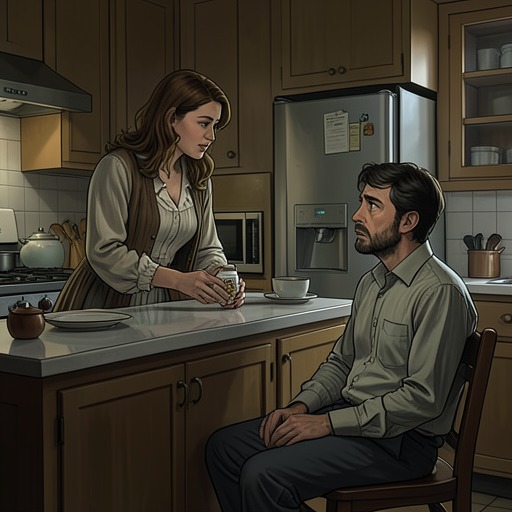
Elizabeth returns to Stephen and takes his hand, then kisses him on the lips. She tells him that it may be time to cut down on coffee because the caffeine cannot be good for him. Stephen accepts her judgment, answering that whatever she thinks is best is fine. The exchange is gentle and practical: her care takes the form of an ordinary suggestion, and his answer expresses trust rather than resistance.
As Stephen and Bogdan begin another chess game, Elizabeth turns back toward the kitchen. Neither man sees her tears. The closing image holds together the elements that define the marriage: Stephen remains present in a shared routine, Bogdan’s friendship surrounds them, and Elizabeth’s love coexists with grief she cannot make disappear. Her choice to put the medication away and return to Stephen’s hand does not resolve the prospect of loss. It locates her instead in the continuing work of companionship—watching, caring, and taking part in the life still available to them.